


Mozu-Furuichi Kofun Group:
Mounded Tombs of Ancient Japan
大阪府/世界遺産登録2019年
百舌鳥・古市古墳群 - 古代日本の墳墓群 -
3世紀半ばから6世紀いっぱい、“古墳”と呼ばれる独特の墳墓が日本列島の社会秩序を形作りました。
「古墳時代」と呼ばれ、前期(3世紀半ばから4世紀半ば)・中期(4世紀後半から5世紀)・後期(6世紀)と区分されます。
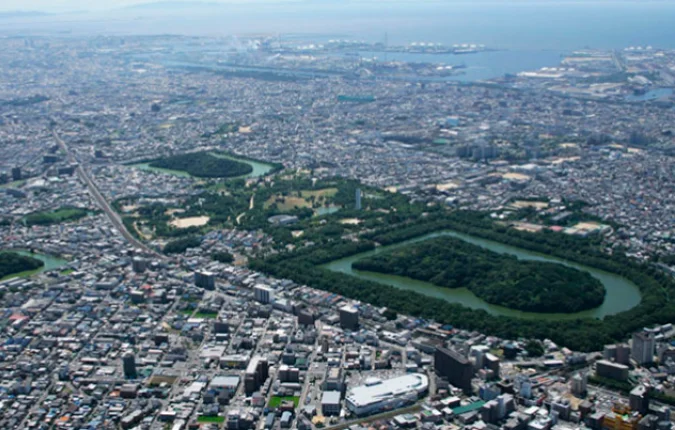
「百舌鳥・古市古墳群」は、大阪平野に築かれた49基の古墳から成り、
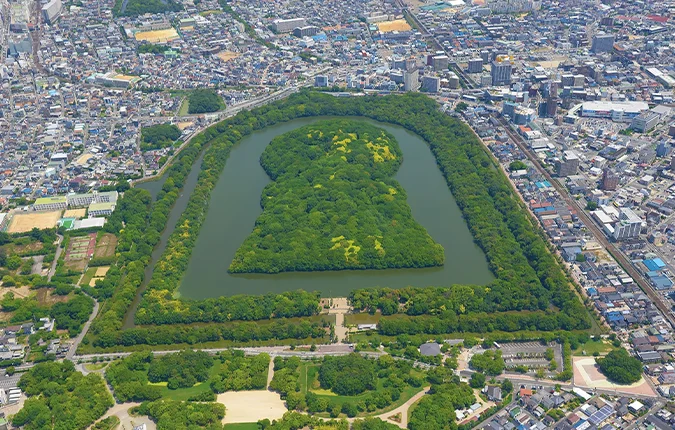
墳丘長486mの大山古墳(仁徳天皇陵古墳)を頂点とする古墳時代中期の代表的遺産です。
前方後円墳・帆立貝形墳・円墳・方墳という4類型による階層秩序が明確に示されています。
この時代、倭王は中国南朝の宋から王号を授けられ、朝鮮半島の政治・軍事にも関与していました。
古墳の規模と型式による秩序という古墳時代の政治構造を最も分かりやすく見せてくれる古墳群として、
世界文化遺産に登録されています。
【文化遺産オンライン(文化庁)】
https://bunka.nii.ac.jp/special_content/hlinkJ
【堺市観光コンベンション協会】
https://www.sakai-tcb.or.jp/
Mozu-Furuichi Kofun Group: Mounded Tombs of Ancient Japan
From the mid-3rd century to the end of the 6th century, unique burial mounds called "kofun" shaped the social order of the Japanese archipelago. This period is called the "Kofun era" and is divided into the Early Period (mid-3rd to mid-4th century), Middle Period (late 4th to 5th century), and Late Period (6th century).
The "Mozu-Furuichi Kofun Group" consists of 49 kofun built on the Osaka Plain and is a representative heritage of the Middle Kofun era, with the 486-meter-long Daisen-ryo Kofun (Imperial Mausoleum) at its pinnacle. A hierarchical order is clearly demonstrated through four types: keyhole-shaped kofun, scallop-shaped kofun, round kofun, and square kofun. During this period, kings were granted royal titles by the Southern Dynasties of China and were also involved in the politics and military affairs of the Korean Peninsula. This kofun group is registered as a World Cultural Heritage site as it most clearly demonstrates the political structure of the Kofun era through the order based on the scale and types of kofun.
-
【UNESCO World Heritage Center】
https://whc.unesco.org/en/list/1593 -
【SAKAI tourism & convention Guide】
https://www.sakai-tcb.or.jp/en/
百舌鸟古市古坟群
大大小小的“古坟”建造于3世纪中叶。尤其在4世纪末至5世纪中后期,与大阪湾相邻的平野上陆续出现了超过300米的巨大前方后圆坟。该遗产群表现了无可比拟的土木技术以及被称为“古坟时代”的日本独特的历史时期。
百舌鳥古市古墳群
自3世紀中期起,開始興建大大小小的「古墳」。尤其是4世紀末至 5世紀後期,於接壤大阪灣的平原,陸續出現長度超過300公尺,巨大的前方後圓墳。表現罕見的土木技術和被稱為「古墳時代」(日本獨特的一個時代)的遺產群。
-
【堺市觀光嚮導】
https://www.sakai-tcb.or.jp/zh-tw/
모즈・후루이치 고분군
일본에서 크고 작은 '고분'이 축조되기 시작한 것은 3 세기 중엽부터의 일. 특히 4 세기 말부터 5 세기 후반에 걸쳐 오사카 만에 접한 평야에 300m 가 넘는 거대한 전방후원분이 잇따라 모습을 드러냈습니다. 유례를 찾아볼 수 없는 토목 기술과 '고분 시대'로 불리는 일본 특유의 한 시대를 표현하고 있는 유산군입니다.
-
【사카이 관광안내】
https://www.sakai-tcb.or.jp/ko/
Ensemble de kofun de Mozu-Furuichi : tertres funéraires de l’ancien Japon
À partir du milieu du IIIe siècle après J.-C., des monticules funéraires appelés « kofun » commencèrent à être érigés au Japon. De la fin du IVe siècle à la seconde moitié du Ve siècle en particulier, de vastes monticules funéraires en forme de trou de serrure de plus de 300 mètres de long sont apparus dans la plaine face à la baie d’Osaka. Ce groupe de monticules cristallise d’incomparables compétences en génie civil et une période unique dans l’histoire japonaise connue sous le nom de la période Kofun.
-
【UNESCO World Heritage Center】
https://whc.unesco.org/fr/list/1593/
Mozu-Furuichi Kofun-Gruppe : Grabhügel des antiken Japans
So genannte “Kofun”-Grabstätten wurden etwa ab Mitte des 3. Jahrhunderts nach Christus in Japan erbaut. Etwa Ende des 4. Jahrhunderts bis in die späte Hälfte des 5. Jahrhunderts wurden riesige Grabstätten in Form eines Schlüssellochs in der Ebene vor der Bucht von Osaka erbaut. Sie erreichen eine Länge von mehr als 300 Metern. Die Grabstätten erinnern an diese herausragende Baukunst sowie eine einzigartige Zeit in der japanischen Geschichte, die auch als Kofun-Zeit bekannt ist.
Gruppo di kofun di Mozu-Furuichi: tumuli funerari del Giappone antico
Dalla metà del III secolo d.C. cominciarono a sorgere in Giappone tumuli funerari chiamati "kofun". In particolare, dalla fine del IV secolo alla seconda metà del V secolo, vasti tumuli funerari della lunghezza di oltre 300 metri e dalla forma simile a quella di un buco della serratura cominciarono ad apparire nella pianura di fronte alla baia di Osaka. Questo gruppo di tumuli è una testimonianza di superbe capacità ingegneristiche e dà il nome a una fase unica della storia giapponese, il periodo Kofun.
Conjunto de ‘kofun’ de Mozu-Furuichi - Túmulos funerarios del antiguo Japón -
Desde mediados del siglo III, se empezaron a construir en Japón estos túmulos, denominados “kofun”. Desde finales del siglo IV hasta la segunda mitad del siglo V en concreto, aparecieron extensos túmulos en forma de ojo de cerradura de más de 300 metros de longitud en la llanura situada junto a la bahía de Osaka. Este grupo de túmulos representa unos niveles excepcionales de conocimientos de ingeniería civil y un periodo único en la historia japonesa conocido como el Periodo Kofun.
Grupo de Kofun de Mozu-Furuichi: Túmulos do Japão Antigo
A partir de meados do século III d. C., os túmulos denominados “kofun” começaram a ser construídos no Japão. A partir do final do século IV até à metade final do século V, nomeadamente, apareceram grandes túmulos de família com mais de 300 metros de comprimento na planície voltada para a Baía de Osaka. Este grupo de túmulos representa os níveis superbos de competências de engenharia e um período único na história japonesa conhecido como o Período Kofun.
Группа курганов Модзу-Фуруити Кофунгун : гробницы древней Японии
С середины третьего века нашей эры в Японии начали возводить курганы, называемые кофунами. В частности, с конца четвертого века до второй половины пятого века на равнине, обращенной к заливу Осака, появились огромные могильные курганы в виде замочной скважины длиной более 300 метров. Эта группа курганов является превосходным образцом развитого гражданского строительства и иллюстрирует уникальный период в истории Японии, известный как период Кофун.