


Itsukushima
Shinto Shrine
広島県廿日市市/世界遺産登録1996年
嚴島神社
広島県廿日市市宮島宮島の厳島神社は、
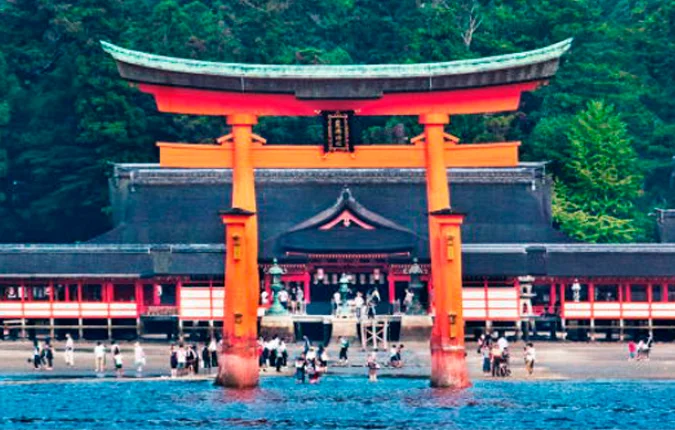
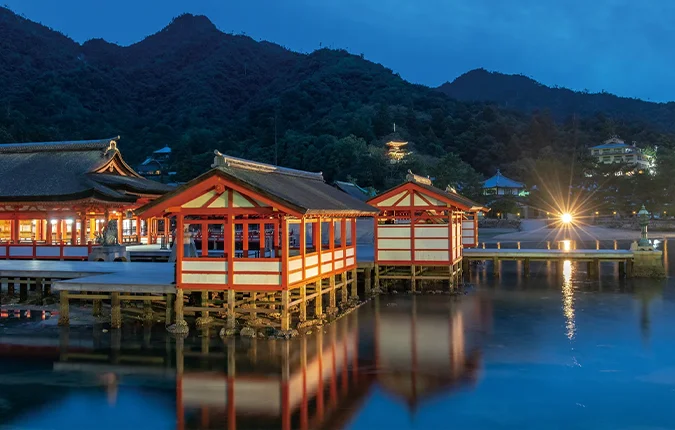
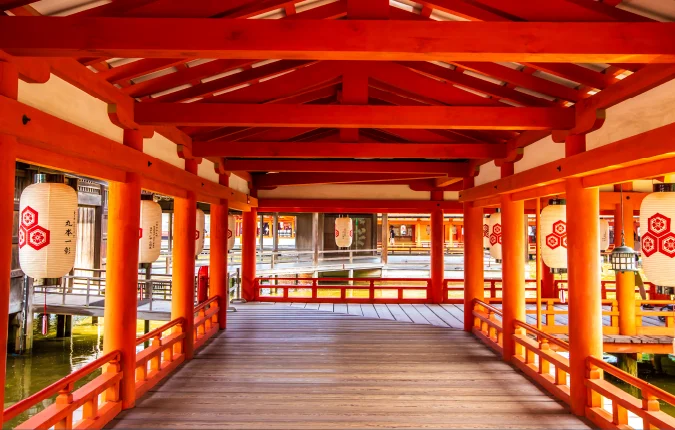
彌山を背に海上から立ち上がる朱塗りの社殿~と大鳥居が日本人の美意識の基準となった世界文化遺産です。
仁平元年(1151)に平清盛(1118~1181)が安芸守に就任し、
仁安3年(1168)に現在の形に造営されました。
清盛は日宋貿易ルートの要衝として厳島を重視し、厳島神社は日本を代表する神社となります。
平家滅亡後も源頼朝(1147~1199)の保護、
毛利元就(1497~1571)や豊臣秀吉(1537~1598)による修復・造営が続き、
江戸時代には浅野家による大鳥居再建が重ねられました。
明治時代の廃仏毀釈で一度彩色が剥がされる惨事もありましたが、歴史に忠実な人々によって朱塗りに復旧されました。
室町時代後期以降、庶民信仰が広がり、江戸時代中期には日本三景の一つとして賞賛されるようになりました。
【文化遺産オンライン(文化庁)HP】https://bunka.nii.ac.jp/special_content/hlink6
【宮島観光協会】
http://www.miyajima.or.jp/

Itsukushima Shinto Shrine
Itsukushima Shrine in Hatsukaichi City, Hiroshima Prefecture, is a World Cultural Heritage site where the vermilion-painted shrine buildings and the great torii rising from the sea with Mount Misen in the background have become the standard of Japanese aesthetic sense. In the 1st year of Ninpei (1151), Taira no Kiyomori (1118-1181) assumed the position of Aki no Kami (Governor of Aki Province), and in the 3rd year of Nin'an (1168), it was constructed in its current form. Kiyomori valued Itsukushima as a strategic point on the Japan-Song trade route, and Itsukushima Shrine became one of Japan's representative shrines.
Even after the fall of the Taira clan, protection by Minamoto no Yoritomo (1147-1199), restoration and construction by Mōri Motonari (1497-1571) and Toyotomi Hideyoshi (1537-1598) continued, and during the Edo period, reconstruction of the great torii was repeatedly carried out by the Asano family. Although there was once a disaster when the colored painting was removed during the Abolition of the Buddha in the Meiji period, it was restored to vermilion paint by people faithful to history.
From the late Muromachi period onward, commoner faith spread, and by the mid-Edo period it came to be praised as one of the Three Views of Japan.
-
【UNESCO World Heritage Center】
https://whc.unesco.org/en/list/776 -
【Miyajima Tourist Association】
https://www.miyajima.or.jp/english/index.php -
【Dive! Hiroshima】
https://dive-hiroshima.com/en/
严島神社
从12世纪前后起,时代的主角由贵族转移到了武士阶级。严岛神社就是由当时的权势者兴建的神社。立足于海上、以背景的山体作为神体来祭祀,严岛神社作为了解日本人的审美情趣及宗教空间的建筑而被收录于世界文化遗产中。
-
【Dive! Hiroshima】
https://dive-hiroshima.com/cn/
嚴島神社
約從十二世紀開始,時代的主角由貴族轉變為武士。當時的當權者所建造的即為嚴島神社。嚴島神社便由當時的當權者所建造。嚴島神社位於海上,背倚群山,並將山等自然環境作為神體供奉等等,是能使人體會日本美學意識及宗教空間特質的建築物,因而獲指定為世界文化遺產。
-
【Dive! Hiroshima】
https://dive-hiroshima.com/tw/
이쯔쿠시마 신사
12세기경부터 시대의 주역은 귀족에서 무사로 옮겨져 갔습니다. 당대 최고의 권력자에 의해 지어진 것이 이쯔쿠시마 신사입니다. 바다 위에 입지하고 뒤에 두른 산을 어신체(御神体)로 모시는 등, 일본의 미의식과 종교적 공간의 특성을 이해할 수 있는 건축물로 세계 문화 유산에 지정되었습니다.
-
【Dive! Hiroshima】
https://dive-hiroshima.com/kr/
Sanctuaire shinto d'Itsukushima
A partir du 12ème siècle, la noblesse a peu à peu cédé le rôle principal de l'époque aux samouraïs. Le Sanctuaire d'Itsukushima a été construit par le pouvoir alors en place. Entouré par la mer et dominé par un paysage de montagnes révérées comme le lieu de résidence des divinités shintoïstes, il a été enregistré au Patrimoine culturel mondial comme une construction permettant de comprendre la conception esthétique et les particularités des espaces religieux du Japon.
-
【UNESCO World Heritage Center】
https://whc.unesco.org/fr/list/776/ -
【Dive! Hiroshima】
https://dive-hiroshima.com/fr/
Itsukushima-Schrein
Ab dem 12. Jahrhundert begann das Zeitalter, in dem die Kriegerklans die Hauptrolle vom Adel übernahm. Der Itsukushima-Schrein wurde von den Machthabern dieser Zeit erbaut. Der Schrein liegt am beziehungsweise teilweise im Meer und die Berge, usw. im Hintergrund werden als Gottheiten verehrt. Das Gebäude wurde als Weltkulturgut ausgewiesen, weil man dort ein Verständnis für die besonderen Merkmale des ästhetischen Bewusstseins und der religiösen Räume Japans gewinnen kann.
-
【Dive! Hiroshima】
https://dive-hiroshima.com/de/
Il tempio shintoista di Itsukushima
Dal dodicesimo secolo il potere passò dalle mani dei nobili di corte a quelle dei bushi (samurai), l'aristocrazia guerriera. I potenti di quel periodo edificarono il santuario di Itsukushima. Viene annoverato tra i patrimoni dell'umanità in quanto edificio esprimente le peculiarità dell'estetica e dello spazio religioso giapponesi.
Santuario sintoísta de Itsukushima
Desde el siglo XII, el protagonismo de la época se trasladó desde la nobleza a los samurai. El santuario sintoísta de Itsukushima fue construido por los poderosos de esa época. Construido sobre del agua, fue declarado Patrimonio Cultural de la Humanidad por estar dedicado a la adoración de las montañas como divinidad, por ser una construcción que permite comprender las características del espacio religioso y del sentido estético de Japón, etc.
-
【UNESCO World Heritage Center】
https://whc.unesco.org/en/list/776
Santuário de Itsukushima
A partir do século XII, o poder no Japão passou gradualmente da nobreza para a classe dos samurais. O Santuário Xintoísta de Itsukushima foi construído sob o patrocínio dos governantes da época. Erguido sobre o mar e tendo as montanhas como pano de fundo, este santuário venerado expressa de forma notável os conceitos japoneses de beleza e de espaço sagrado, sendo reconhecido como Património Cultural Mundial.
Святилище Ицукусима
Примерно с XII века ведущая роль в японском обществе постепенно перешла от аристократии к военному сословию. Святилище Ицукусима было возведено правителями того времени. Расположенное над морем и обращённое к горам, почитаемым как священные объекты, оно является выдающимся примером синтоистской архитектуры, позволяющим понять особенности японской эстетики и религиственного пространства. Именно за эти качества святилище было включено в Список Всемирного культурного наследия.
-
【UNESCO World Heritage Center】
https://whc.unesco.org/en/list/776